
Meet Double or Nothing – progressive recovery robots for traders who understand the risk
The idea behind Double or Nothing is simple:
- start with a relatively small position,
- add new positions if price moves against the basket, and
- use the new weighted average price to try to close the complete basket on a later market retracement.
That is the core principle behind our Double or Nothing family of MetaTrader Expert Advisors.
It can be an effective recovery mechanism when the market keeps producing pullbacks. But it can also become very aggressive when price continues moving in the same direction without enough retracement.
So this is not a robot you should install without understanding what happens when the basket reaches deeper recovery levels.
The basic idea in plain English
Imagine the robot opens a BUY trade and the market immediately moves against it.
Instead of closing the first trade straight away, the EA may open a second position at a lower price. If the market continues lower, another position can be added, and so on.
A simplified lot progression might look like this:
0.03 → 0.06 → 0.12 → 0.24 → 0.48 → 0.96
The later positions change the average entry price of the whole basket.
That means the market may not need to return all the way to the original first entry. A smaller retracement may be enough for the EA to close the complete basket.
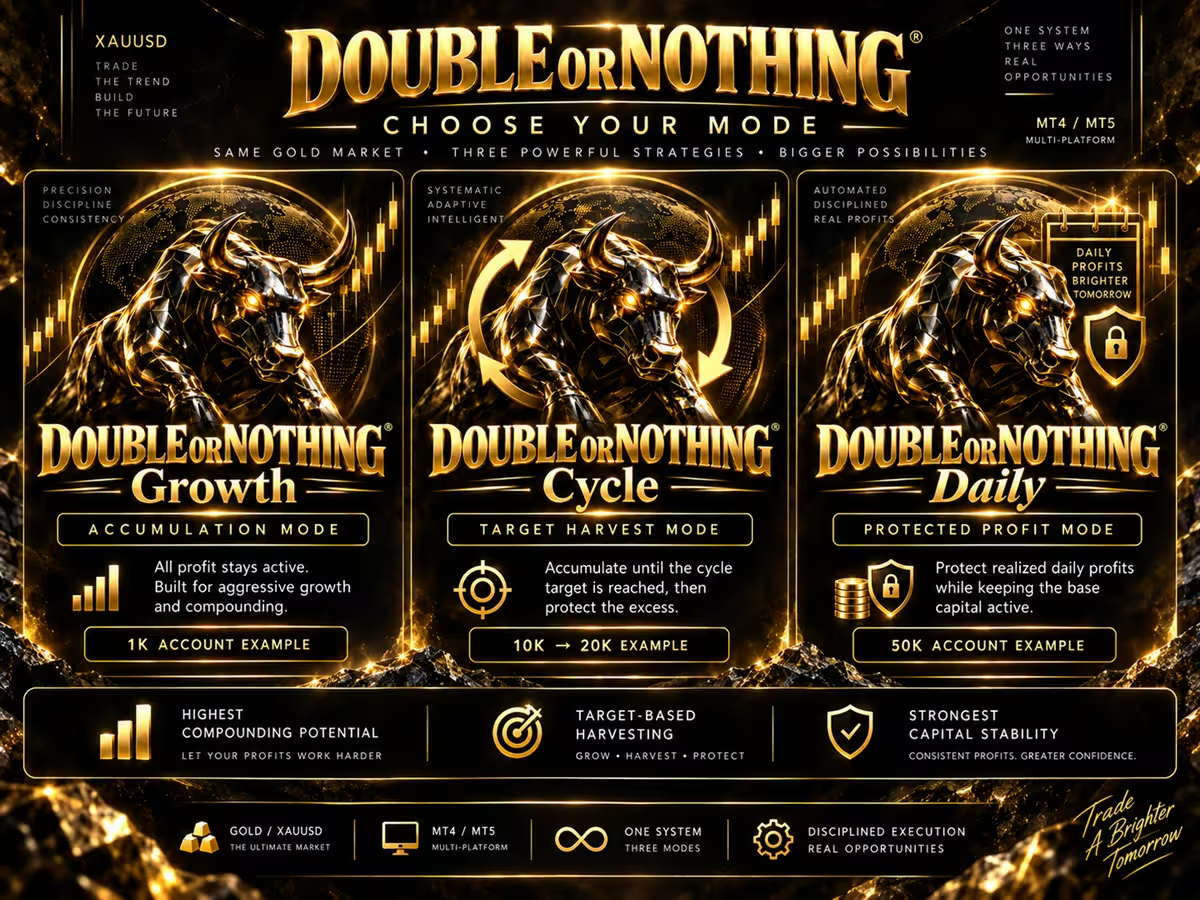
Why traders are interested in this style
| What traders want | How progressive recovery approaches it |
|---|---|
| “I don’t want to close every small adverse move immediately.” | The EA can add recovery positions instead of treating the first adverse move as the final result. |
| “I want the basket to recover before price returns to the first entry.” | Additional positions move the weighted average entry price closer to the current market. |
| “I don’t want to manage several recovery positions manually.” | The EA handles the recovery levels, lot sizes and basket exit automatically. |
| “I want different risk profiles.” | Different Double or Nothing versions can use different ladders, grid distances, targets and recovery rules. |
The trade-off is important: the deeper the recovery goes, the larger the total exposure can become.
How a recovery basket develops
- First entry – the robot opens its initial BUY or SELL position when its entry conditions are met.
- Price moves against the trade – the EA waits for the predefined recovery distance.
- A new level opens – another position is added to the basket.
- The average price changes – the new trade influences the weighted average entry of all open positions.
- The process may repeat – if price continues in the adverse direction, deeper recovery levels can be opened.
- The basket closes on recovery – once price reaches the EA’s recovery target, the robot attempts to close the group of positions.
Is Double or Nothing a martingale robot?
Some versions can behave similarly to a martingale strategy, while others use slower custom lot ladders.
A classic martingale normally doubles the position after a loss. A progressive recovery EA can instead use any predefined sequence.
For example:
- Aggressive: 0.03 → 0.06 → 0.12 → 0.24 → 0.48…
- Softer progression: 0.01 → 0.02 → 0.03 → 0.04 → 0.05…
The label matters less than the mathematics.
If position size grows quickly, total exposure can also grow very quickly.
The biggest risk: exposure does not grow slowly
This is the part every user should understand before running one of these robots.
Using an aggressive doubling sequence:
0.03 + 0.06 + 0.12 + 0.24 + 0.48 + 0.96 + 1.92 + 3.84 = 7.65 lots
If the sequence continues with 7.68, 15.36 or 30.72 lots, the basket becomes dramatically more sensitive to price movement and margin requirements.
This is why a robot can produce many profitable baskets and still experience a very large drawdown during one prolonged directional move.
Important: a high win rate does not automatically mean a low-risk strategy. For recovery systems, maximum equity drawdown, basket depth, total lots and margin level are usually much more important.
Why balance and equity can tell two very different stories
Progressive recovery robots can sometimes show a smooth balance curve while carrying a much larger floating loss.
| Metric | What it shows |
|---|---|
| Balance | Profit and loss from trades that have already been closed. |
| Equity | Your balance plus the current floating profit or loss of all open positions. |
| Equity drawdown | How much the account value fell while positions were still open. |
| Margin level | How much room remains before margin pressure becomes dangerous. |
For a Double or Nothing robot, checking only closed profit is not enough.
You should always look at the deepest basket and ask:
- How many recovery levels were open?
- How many total lots were exposed?
- What was the maximum floating loss?
- How low did the margin level fall?
- How long did the basket remain open?
Example: the DN12 approach
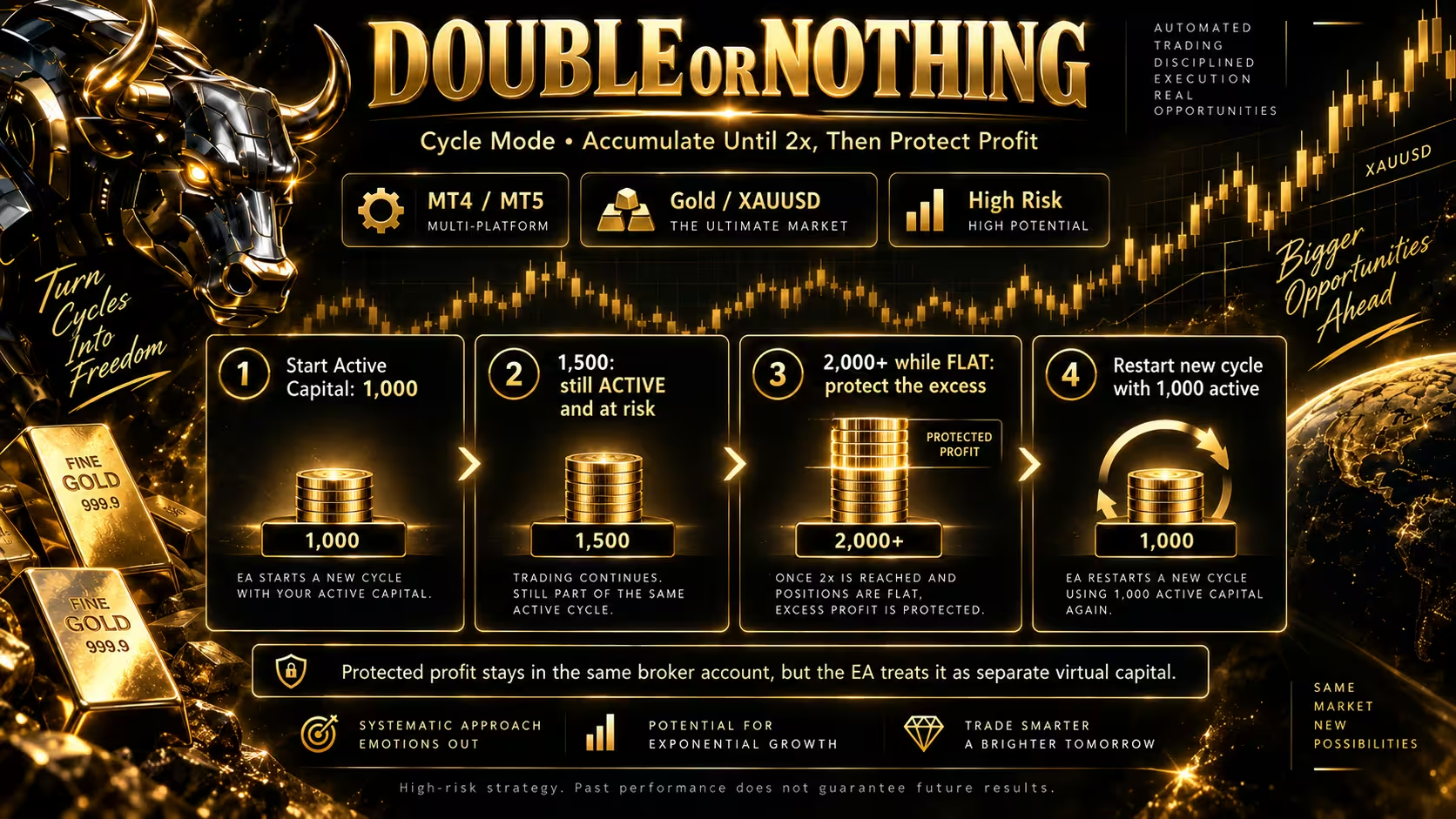
Different Double or Nothing editions are built around the same broad recovery concept but may use different:
- initial lot sizes,
- lot progressions,
- grid distances,
- maximum recovery levels,
- entry conditions,
- basket profit targets, and
- risk controls.
That is why you should always check the settings of the exact version you are using rather than assuming every Double or Nothing EA behaves identically.
Why cent accounts are particularly useful for this type of robot
A cent account is one of the most useful environments for testing aggressive recovery EAs with real-money execution.
Instead of displaying the account in full dollars, the balance is shown in cents.
$100 real money ≈ 10,000 cents displayed in the trading account.
This makes it possible to test live execution with much smaller real capital than would normally be required on a standard account.
| Demo account | Cent account | Standard account |
|---|---|---|
| No real capital at risk | Small real-money exposure | Normal real-money exposure |
| Best for first tests | Useful for live validation | Usually only after extensive testing |
| Simulated environment | Real execution conditions | Real execution conditions |
| No emotional impact | Some real-money psychology | Full monetary impact |
A cent account does not make the strategy safe.
If you deposit $100 and the robot loses the complete cent account, you still lose $100.
The advantage is simply that you can observe the EA under real execution with a smaller absolute amount of capital.
Who is this type of robot for?
Double or Nothing EAs are not designed for everyone.
| May be suitable for | Probably not suitable for |
|---|---|
| Users who understand basket and grid trading | Users looking for very low drawdown |
| Traders comfortable with significant floating losses | Anyone expecting guaranteed monthly income |
| Users willing to test extensively before scaling | Users who do not understand leverage and margin |
| Traders using speculative capital | Anyone trading essential savings or borrowed money |
| Users prepared to monitor margin and exposure | Traders who want a fully passive “safe income” product |
How to test a Double or Nothing EA properly
- Start with a long historical backtest – not just a few good weeks.
- Look at equity drawdown – not only the final profit.
- Inspect the worst basket – maximum levels, total lots and margin usage.
- Run the EA on demo – make sure you understand what it does in real time.
- Consider a cent account – useful for testing real execution with smaller actual capital.
- Keep the initial lot small – especially before you have observed a full deep-recovery cycle.
- Scale slowly – a strategy that works with a tiny base lot can behave very differently when exposure is multiplied.
Tip: before increasing the lot size, calculate the total exposure if the EA reaches its deepest allowed recovery level. The first trade is usually not the dangerous part — the full basket is.
Main advantages and disadvantages
| Advantages | Disadvantages |
|---|---|
| Automates complex basket management | Exposure can increase rapidly |
| Can recover after relatively small market retracements | Large floating drawdowns are possible |
| Initial trade can be relatively small | Strong directional markets can be dangerous |
| Different versions can use different risk profiles | Margin call and stop-out remain possible |
| Can be extensively backtested in MetaTrader | Backtests cannot reproduce every live execution condition |
How to get a Double or Nothing robot
There are three ways to access our Double or Nothing EAs.
1. Buy or rent through MQL5
The easiest option for existing MetaTrader users is to use our MQL5 seller page.
MQL5 handles its own product delivery and activation system.
2. Get an eligible version free through a partner broker
Selected Double or Nothing versions may be available free to eligible users who open and validate a trading account through one of our partner links.
IQTradeEasy may receive an affiliate commission if you open or fund an account through these links.
Availability may depend on your country, account type, broker and the specific robot version.
3. Buy directly from IQTradeEasy
We also plan to offer selected Double or Nothing versions directly through IQTradeEasy, including payment via PayPal.
Direct versions may later use account-based licensing, allowing the EA to run only on authorised MetaTrader account numbers.
This option is not active yet and will be added when direct licensing becomes available.
Which partner broker makes most sense for testing?
| Broker | Why it may be useful | Link |
|---|---|---|
| IQ Broker | MetaTrader access for supported users and markets. | Open IQ Broker |
| XM | Established MetaTrader broker with multiple account options depending on region. | Open XM |
| RoboForex | Particularly interesting for users looking for smaller-scale or cent-style EA testing where available. | Open RoboForex |
Does a profitable backtest mean the EA is safe?
No.
A backtest shows how a specific configuration would have behaved using the historical data and testing assumptions available to MetaTrader.
Live results can differ because of:
- spread,
- commission,
- swap,
- slippage,
- broker price feed,
- contract specifications,
- leverage, and
- execution speed.
A robot that survived one historical period can also encounter a future market move that was not present in the test sample.
Use backtests to understand the strategy — not as a guarantee of future results.
Frequently asked questions
Can Double or Nothing lose the entire account?
Yes. A leveraged progressive recovery strategy can reach margin call or stop-out if total exposure becomes too large relative to the available capital.
Does a high win rate make it safe?
No. A recovery EA can close many profitable baskets and still suffer one very large drawdown. Win rate should always be considered together with equity drawdown and maximum exposure.
Should I start on demo?
Yes. Demo is the best place to understand how the robot opens levels, how quickly exposure grows and how the complete basket is closed.
Why use a cent account after demo?
A cent account can provide real execution with a much smaller absolute amount of money at risk. It is useful as an intermediate step before considering a normal live account.
Can I run it on any MetaTrader broker?
Compatibility depends on the specific EA, MetaTrader version, symbol specifications and broker conditions. Always test the exact version with the broker you intend to use.
Can I copy the EA to unlimited accounts?
MQL5 products use the MQL5 Market activation system. Future direct IQTradeEasy licences may instead be restricted to specifically authorised MetaTrader accounts.
Bottom line
Double or Nothing robots are built around one powerful idea:
use additional recovery positions to move the basket’s average entry closer to the current market price.
When the market retraces repeatedly, that mechanism can close baskets efficiently.
When the market keeps moving strongly in one direction, the same mechanism can create very large exposure.
So the right question is not simply:
“How often does the robot win?”
The more important question is:
“How much exposure and drawdown can it require before those wins are achieved?”
If you understand that trade-off, test carefully and size the account appropriately, Double or Nothing can be an interesting automated strategy to explore.