
Meet Strategy Detective – discover how a trading robot behaves without seeing its source code
Have you ever watched an Expert Advisor trade and wondered:
- What triggers its entries?
- How far apart are its recovery levels?
- How does its lot size increase?
- Why does it sometimes stop adding positions?
- Does it use higher-timeframe trend or volatility filters?
Strategy Detective is designed to help answer those questions by analyzing what the robot actually does in the trading account.
It does not decompile EX4 or EX5 files, and it does not recover hidden source code.
Instead, it works like a forensic trading analyst: it observes positions, trade history, and market conditions, then searches for recurring behavioral patterns.
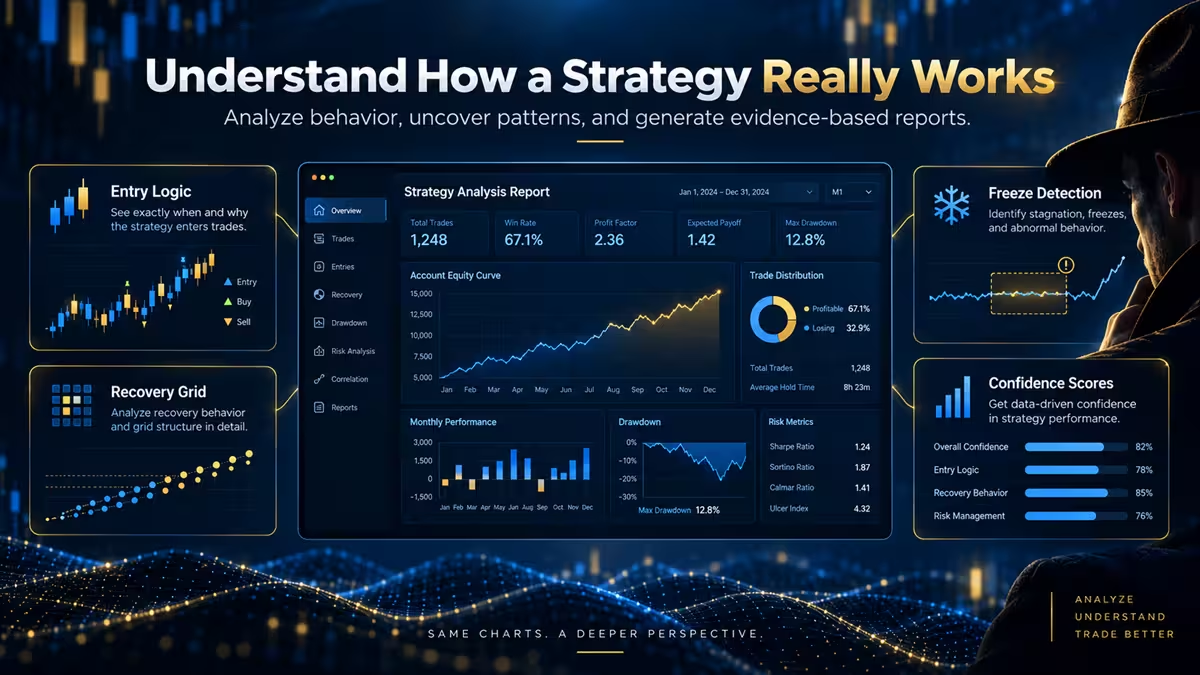
What Strategy Detective actually does
The basic idea is simple:
Watch the trades → record the market context → find repeated relationships → build a behavioural profile.
The EA can run on a MetaTrader chart while another robot is trading on the same account.
Strategy Detective does not need to know how the original EA was programmed. It analyses the trading behavior visible from the account.
| Question | What Strategy Detective looks for |
|---|---|
| “Is this a grid or recovery system?” | Measures distances between consecutive trade levels. |
| “Does the lot size follow a progression?” | Compares position sizes between successive entries. |
| “Does the EA behave differently at deep levels?” | Separates early entries from deeper recovery levels. |
| “Does higher-timeframe direction matter?” | Records M15, M30, and H1 market context around entries. |
| “Why did the robot stop adding levels?” | Detects possible freeze or pause events after adverse price movement. |
| “Can BUY and SELL positions exist together?” | Measures opposite-side overlap in observed positions. |
Think of it as a black-box strategy analyzer
In engineering, a black-box analysis studies how a system behaves by observing its inputs and outputs without needing access to its internal implementation.
Strategy Detective applies the same idea to automated trading.
- The original EA trades normally.
- Strategy Detective observes the resulting trades.
- It records market conditions around those trades.
- It compares hundreds or thousands of observations.
- It identifies repeated behavioral patterns.
- It generates an HTML report summarising the evidence.
The objective is not to claim that a hidden rule has been proven from one observation.
The objective is to separate what is clearly observed from what is merely possible.
What can Strategy Detective estimate?
Depending on the number and quality of available observations, the software can analyze several important aspects of a trading strategy.
| Analysis block | What it can reveal |
|---|---|
| Grid spacing | Estimated price distance between consecutive recovery levels. |
| Lot progression | Typical multiplier or sizing relationship between levels. |
| Initial entries | Market context surrounding first entries. |
| Deep recovery | How behavior changes at later basket levels. |
| Higher timeframes | Possible relationships with M15, M30 or H1 direction. |
| Volatility | ATR conditions around entries and pauses. |
| Freeze behaviour | Cases where price moved further but the robot temporarily stopped adding levels. |
| Opposite-side trading | Whether BUY and SELL positions coexist and how often. |
| Timing | Average delay between levels and observed re-arm behaviour. |
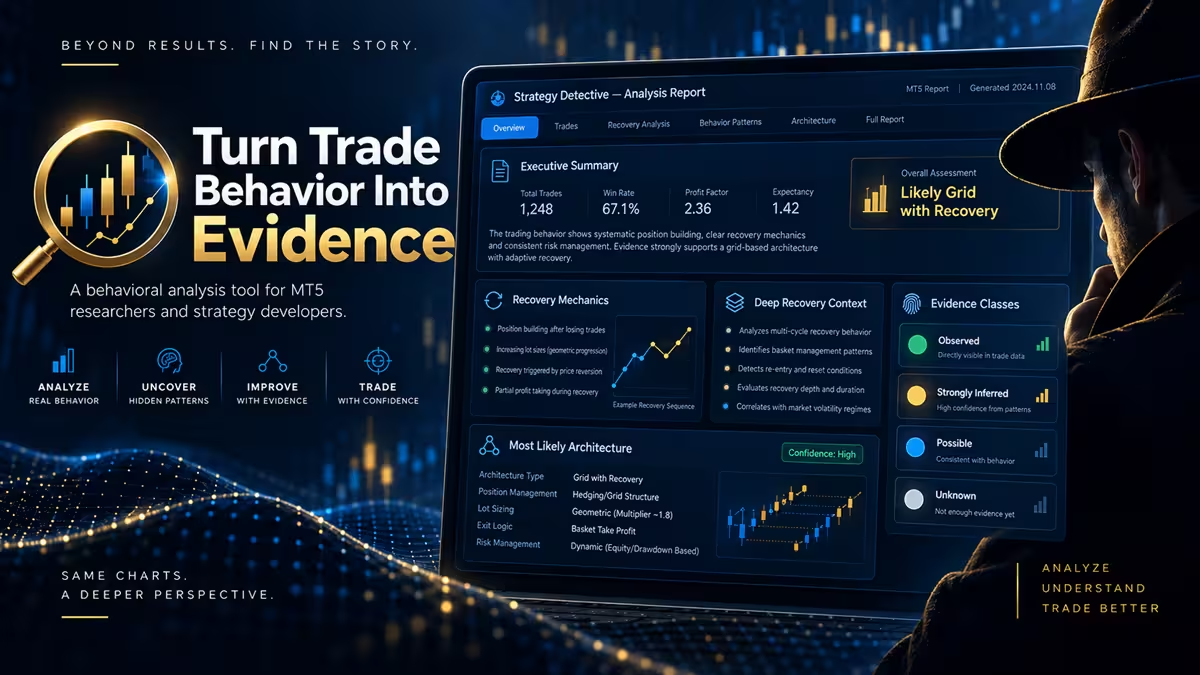
Observed, inferred or unknown: why confidence matters
One of the most important parts of Strategy Detective is that it does not treat every correlation as a proven trading rule.
The report separates findings into evidence categories.
| Classification | What it means |
|---|---|
| Observed | The behavior is directly visible in trades or recorded market data. |
| Strongly inferred | A repeated relationship appears across enough observations to justify further testing. |
| Possible | An interesting correlation exists, but the evidence is not yet strong enough. |
| Unknown | The available data is insufficient or contradictory. |
This distinction is important.
If an EA opened ten trades while H1 was bullish, that does not automatically prove that the EA uses an H1 bullish filter.
There may be another hidden variable producing the same apparent relationship.
Strategy Detective therefore provides a confidence-based behavioral analysis rather than pretending to know the original source code.
A practical example: detecting a hidden grid
Imagine an unknown robot repeatedly opens positions like this:
BUY 0.03
BUY 0.06
BUY 0.12
BUY 0.24
BUY 0.48
Strategy Detective can compare the entry prices and position sizes.
If hundreds of baskets show approximately the same price spacing and a similar lot multiplier, the evidence for a progressive grid becomes much stronger.
Instead of manually examining thousands of trades, the software automatically performs the statistical comparison.
Detecting deep-level behavior
Many recovery robots do not behave exactly the same way at every basket level.
A robot may open the first few levels using simple price spacing, then apply additional filters as exposure increases.
Strategy Detective can separate deeper entries — for example, L7, L8, L9, and beyond — and compare the market environment around them.
- Was H1 moving with or against the trade?
- Were M30 and H1 aligned?
- Was volatility unusually high or low?
- Did the robot pause before adding another level?
- Did an opposite-side basket appear?
This can help identify behavior that is difficult to see from a simple list of orders.
What is a freeze candidate?
A particularly interesting situation occurs when a recovery robot appears to stop adding new levels even though the price continues to move against its basket.
Strategy Detective can flag these events as possible freeze candidates.
For example:
- The robot reaches a deep recovery level.
- Price moves significantly beyond the expected next grid distance.
- No new recovery order appears.
- The pause exceeds the configured observation threshold.
- The software records the market environment during that period.
The report can then compare those freezes with factors such as:
- M15 direction,
- M30 direction,
- H1 direction,
- ATR / volatility,
- basket depth, and
- duration of the pause.
This does not automatically prove why the original EA stopped trading.
It provides evidence you can use to build and test a hypothesis.
Can it discover entry indicators?
It can identify relationships between entries and observable market indicators, but there is an important limitation.
If a trade repeatedly appears near a Stochastic extreme, for example, Strategy Detective can report that relationship.
But correlation does not prove that the original EA actually contains a Stochastic rule.
Strategy Detective tells you what the behaviour is consistent with — not what hidden source-code line definitely exists.
The more independent observations you collect, the stronger or weaker the hypothesis becomes.
What Strategy Detective does not do
This is equally important.
- It does not decompile EX4 files.
- It does not decompile EX5 files.
- It does not recover the original MQL source code.
- It does not bypass EA protection systems.
- It does not claim that statistical correlations are guaranteed hidden rules.
- It does not open, close or modify trades.
It is a behavioral research and analysis tool.
Who is Strategy Detective useful for?
| User | Why it can help |
|---|---|
| EA developers | Study the behavioral structure of other automated strategies and test alternative hypotheses. |
| Strategy researchers | Turn thousands of observed trades into measurable patterns. |
| EA buyers | Understand how a purchased robot actually behaves beyond its marketing description. |
| Portfolio managers | Identify hidden grid, progression, or simultaneous exposure characteristics. |
| Advanced traders | Investigate entry timing, recovery depth, and possible market-regime filters. |
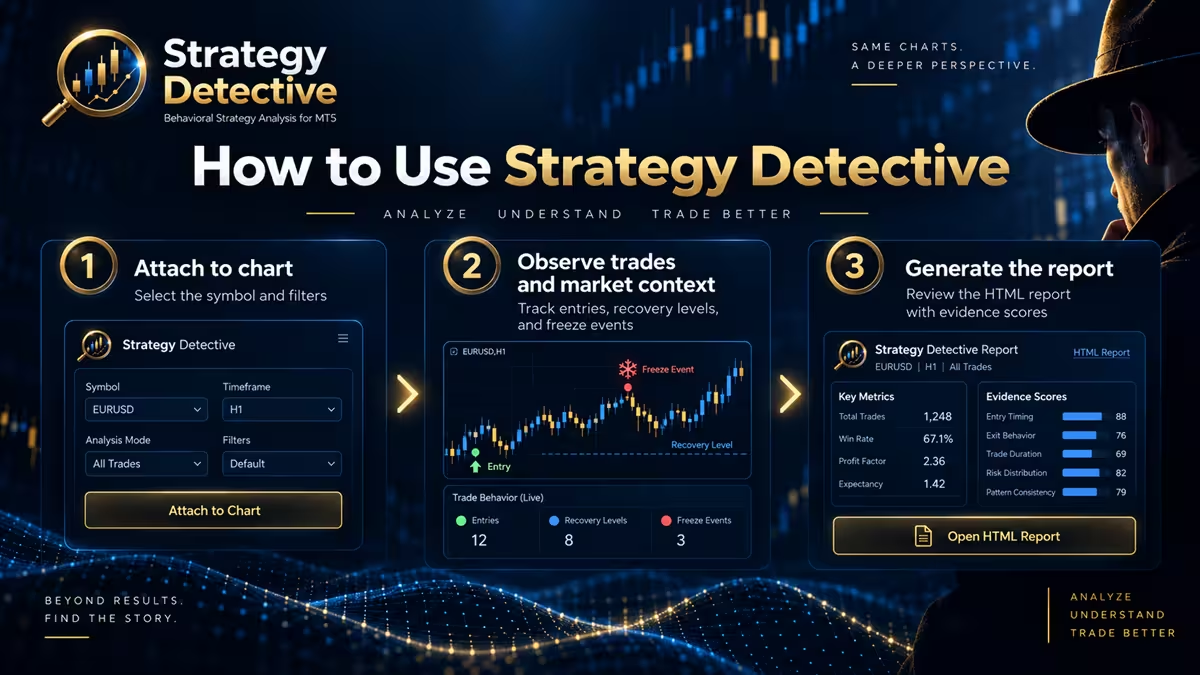
How to use Strategy Detective
- Run the trading robot you want to study on its normal MetaTrader chart.
- Attach Strategy Detective to another chart in the same terminal/account.
- Select the symbol or trading activity you want to analyze.
- Use the comment filter if necessary to isolate a specific robot or strategy.
- Let the system collect enough trades and market snapshots.
- Generate the report and review the strongest behavioral relationships.
- Collect more data before treating uncertain correlations as reliable conclusions.
Tip: the quality of the analysis depends heavily on sample size. Ten trades may suggest an idea. Hundreds or thousands of entries can reveal much stronger patterns.
What the report looks like
Strategy Detective generates a readable HTML report rather than forcing you to analyze raw logs manually.
The report can include sections such as:
- Executive summary
- Entries analysed
- Estimated grid
- Estimated lot multiplier
- Entry context
- Deep recovery context
- Recovery levels
- Freeze candidates
- Possible strategy architecture
- Timing statistics
- Opposite-side overlap
- Current observed state
- Evidence classification
The goal is to make a large amount of trading behavior easier to understand at a glance.
Why more data matters
Behavioral reverse-engineering is fundamentally a statistical problem.
Suppose an unknown EA opens three SELL trades while H1 is bearish.
That tells us very little.
If 800 initial SELL entries repeatedly occur under similar conditions while comparable bullish conditions rarely produce SELL entries, the relationship becomes much more interesting.
The same principle applies to:
- grid spacing,
- lot progression,
- recovery timing,
- deep-level pauses,
- opposite-side entries, and
- market-regime filters.
Strategy Detective is therefore most useful when it is allowed to observe a sufficient variety of market conditions.
Can it recreate another robot automatically?
No.
The software can identify behavioral relationships that may help a developer design and test a similar strategy architecture.
But an observed strategy can contain hidden variables that are impossible to prove from account activity alone.
For example, an original EA might use:
- a proprietary indicator,
- an external data source,
- news information,
- manual intervention,
- hidden timing rules, or
- multiple conditions producing the same visible result.
Strategy Detective therefore helps with research and reconstruction, but it does not guarantee source-code recovery from observation.
Advantages and limitations
| Advantages | Limitations |
|---|---|
| Works without original EA source code | Cannot prove every hidden rule |
| Automates analysis of large trade histories | Needs enough observations for useful statistics |
| Estimates grid and lot progression | Market correlations can produce false hypotheses |
| Studies deep recovery behaviour | Cannot see external data used by the original EA |
| Detects possible freezes and timing patterns | Manual intervention may be indistinguishable from hidden logic |
| Produces a readable HTML report | It is an analysis tool, not an automatic strategy copier |
How to get Strategy Detective
Strategy Detective is available for MetaTrader through the MQL5 Market.
MQL5 handles product delivery and its own activation system.
Frequently asked questions
Does Strategy Detective decompile EX4 or EX5 files?
No. It does not inspect or recover protected source code. It analyses trading behaviour visible through the MetaTrader account.
Do I need the source code of the robot I want to analyse?
No. The purpose of Strategy Detective is specifically to study observable strategy behaviour when the original source code is not available.
Can it identify a martingale or grid?
It can estimate recurring trade spacing and lot-size progression. Repeated observations can provide strong evidence of grid or progressive-recovery behaviour.
Can it tell me exactly which indicator the original EA uses?
Not with certainty. It can identify correlations between entries and observable indicator conditions, but correlation alone does not prove the original EA contains that exact indicator rule.
Does Strategy Detective trade my account?
No. It is designed as an analysis tool and does not need to open, close or modify the strategy’s trades.
How long should I let it collect data?
There is no universal minimum. More trades and more varied market conditions generally produce more useful evidence. A few observations can suggest a hypothesis; hundreds or thousands can provide a much stronger behavioural profile.
Can I analyse only one EA if several robots are running?
Where the trading activity can be identified through order comments or other observable account information, the analysis can be filtered to focus on the strategy being studied.
Bottom line
Strategy Detective is built for one specific problem:
You can see what a trading robot does — but you cannot see why it does it.
The tool helps close that gap by turning observed trading activity into measurable behavioural evidence.
It can help you identify:
- recovery grids,
- lot progressions,
- deep-level behaviour,
- possible market-regime filters,
- freeze or pause patterns,
- opposite-side trading, and
- timing relationships.
It does not promise to reveal hidden source code.
It gives traders and developers something more useful than guessing: structured evidence that can be tested.